
After spending nearly twenty years on the front lines of some of America’s most contested issues—engaged in hand-to-hand political combat—I could no longer shake the feeling that beneath the political crisis tearing our country apart was a deeper spiritual crisis. That crisis, I came to believe, had less to do with politics than with how we were treating the people we disagreed with.
And I was part of the problem.
Give me a complex issue and I could simplify it, flatten the opposition, conjure a villain, and channel outrage against them. I was good at it.
Even when we won, I feared we were losing the country.
I’ll admit, I was afraid to say any of this out loud. Having grown up on the political left and come of age in community organizing, the labor movement, and movements for social and economic justice, it wasn’t exactly popular to suggest that the people we had cast as existential enemies might not be—or that our own solutions might be incomplete.
So I mostly kept those thoughts to myself.
It wasn’t until the golden handcuffs came off that I finally decided to run toward the problem instead of away from it.
Over the next fifteen years, I dedicated myself to listening—really listening—to people whose life experiences, values, and worldviews challenged my own. I discovered that while our disagreements were often real, my assumptions about the people holding them often weren’t.
That journey changed me.
Today there is broad agreement that one of the defining challenges of our time is our inability to talk across our deepest differences. I’ve spent the last fifteen years in the trenches working on that problem—in universities, prisons, faith communities, businesses, civic organizations, and neighborhoods across the country and around the world.
What gives me hope is that I no longer believe our only choices are to defeat one another or split the difference.
The strongest solutions often emerge when we take the deepest truths from competing worldviews while refusing their excesses. Real leadership isn’t about mushy moderation or kumbaya. It’s about bold synthesis—bringing the strongest insights from opposing traditions into conversation until something neither side could have produced alone begins to emerge.
I know there are more and more of us who dread Thanksgiving dinner because we don’t know how to talk to the people we love most. People who feel politically homeless. People who feel isolated in their congregations, workplaces, or communities because genuine curiosity and independent thinking have become risky.
Those are the people I hope this work serves.
I believe democracy is strongest not when we eliminate disagreement, but when we develop the character and skills to engage it well. I believe our differences, difficult as they are, can become a source of wisdom rather than division. And I believe we owe it to our children—and to one another—to leave this country a little stronger than we found it, just as my parents hoped to do for me.
If you, too, are struggling with that nagging sense that beneath our political crisis lies something deeper—and you’re looking for a way to respond with courage, curiosity, and hope—then you’ve come to the right place.
I’m grateful you’re here.
“The strongest solutions often emerge when we take the deepest truths from competing worldviews while refusing their excesses. Real leadership isn’t about mushy moderation or kumbaya. It’s about bold synthesis—bringing the strongest insights from opposing traditions into conversation until something neither side could have produced alone begins to emerge.”
A social entrepreneur and serial nonprofit founder, Simon has spent more than 30 years on the front lines of America’s most polarized conflicts. Over the last 20 years, he has founded seven organizations and initiatives designed to help people engage difference without abandoning conviction.
He is the Founder and President of Cambridge Heath Ventures, Managing Director of the Fund for New Leadership, Senior Advisor at One Voice United and a Senior Fellow at the Harvard Kennedy School’s Middle East Initiative. He co-created Courageous Conversations at The Nantucket Project and launched Bridging the Gap at Interfaith America. At UNC Chapel Hill, he co-created and taught Courageous Conversations: Israel and Palestine on Campus, and at Harvard, he co-instructed Arguing Israel and Palestine.
Across this work, Simon brings together people who rarely share space — conservatives and progressives, secular and evangelical college students, corrections officers and the formerly incarcerated — equipping them to navigate disagreement, forge connections, and solve complex problems together.
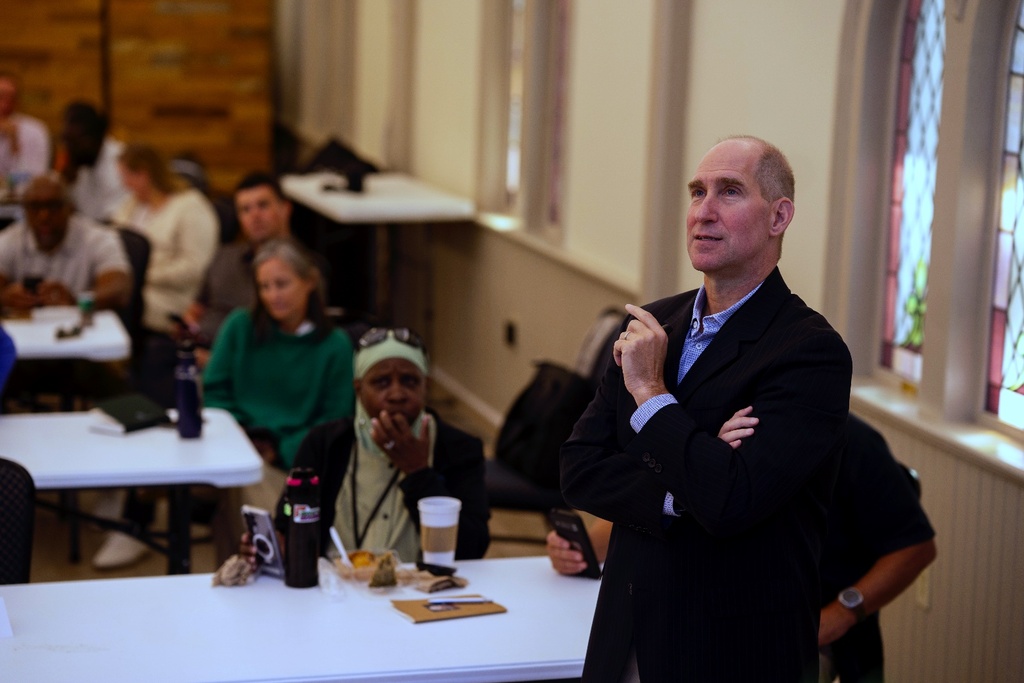
Photo credit: Caryl Lawson
ON THE NATIONAL STAGE
Simon’s belief that listening is both a political act and a spiritual one has taken him from classrooms to national stages. On stage at The Nantucket Project, he has hosted live dialogues with figures across the ideological spectrum, including Sean Spicer, Valerie Jarrett, Karl Rove, Candace Owens, Jonathan Haidt, Juan Williams, Joe Kennedy, Andrew Yang, Ilyasah Shabazz and David Brooks, modeling what it means to stay curious and connected even in disagreement.
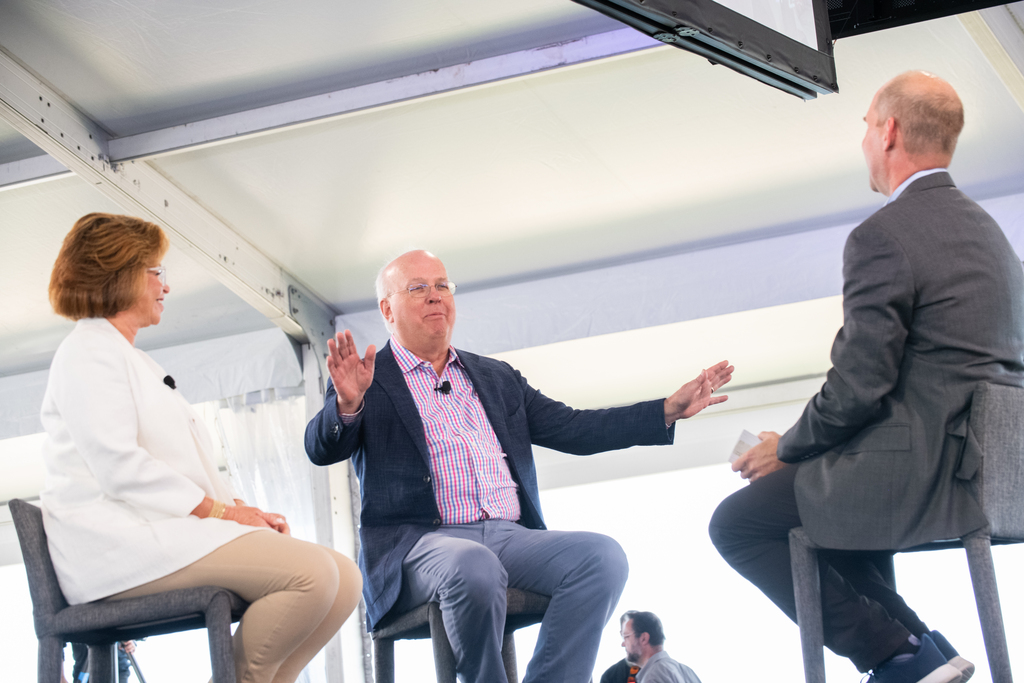
Simon on stage with Valerie Jarrett and Karl Rove at The Nantucket Project. Photo credit: TNP
Simon’s life and work have been featured in several short films, including Bridging the Gap and For the Common Good, as well as The North Carolina Listening Project, which earned him a MidSouth Emmy® Award in 2025 for Interview/Discussion.
These films illuminate Simon’s deeply held belief: that the future depends not on winning arguments but on building relationships — not on certainty, but on curiosity.
2025 · Interview/Discussion
The North Carolina Listening Project
THROUGH THE YEARS
Simon came of age in community organizing, the labor movement, and movements for social and economic justice — engaged in hand-to-hand political combat on some of America’s most contested issues.
He could no longer shake the feeling that beneath the political crisis tearing the country apart was a deeper spiritual crisis — one that had less to do with politics than with how we were treating the people we disagree with.
Working-class conservatives, business leaders, and corrections officers. He wasn’t there to persuade. He was there to listen.
What he learned from years of listening, Simon began putting into practice, co-founding One Voice United, launching the Fund for New Leadership with the Hartman Family Foundation, and piloting the work that would eventually become Courageous Conversations.
Evangelical students met progressive students, and a curriculum for listening across ideological, cultural, and religious divides was born.
Universities, non-profits, corporations, faith communities, and civic institutions seeking to build trust across differences.